
Skin Quality & Tone
Sun damage in Raleigh, reversed and then prevented.
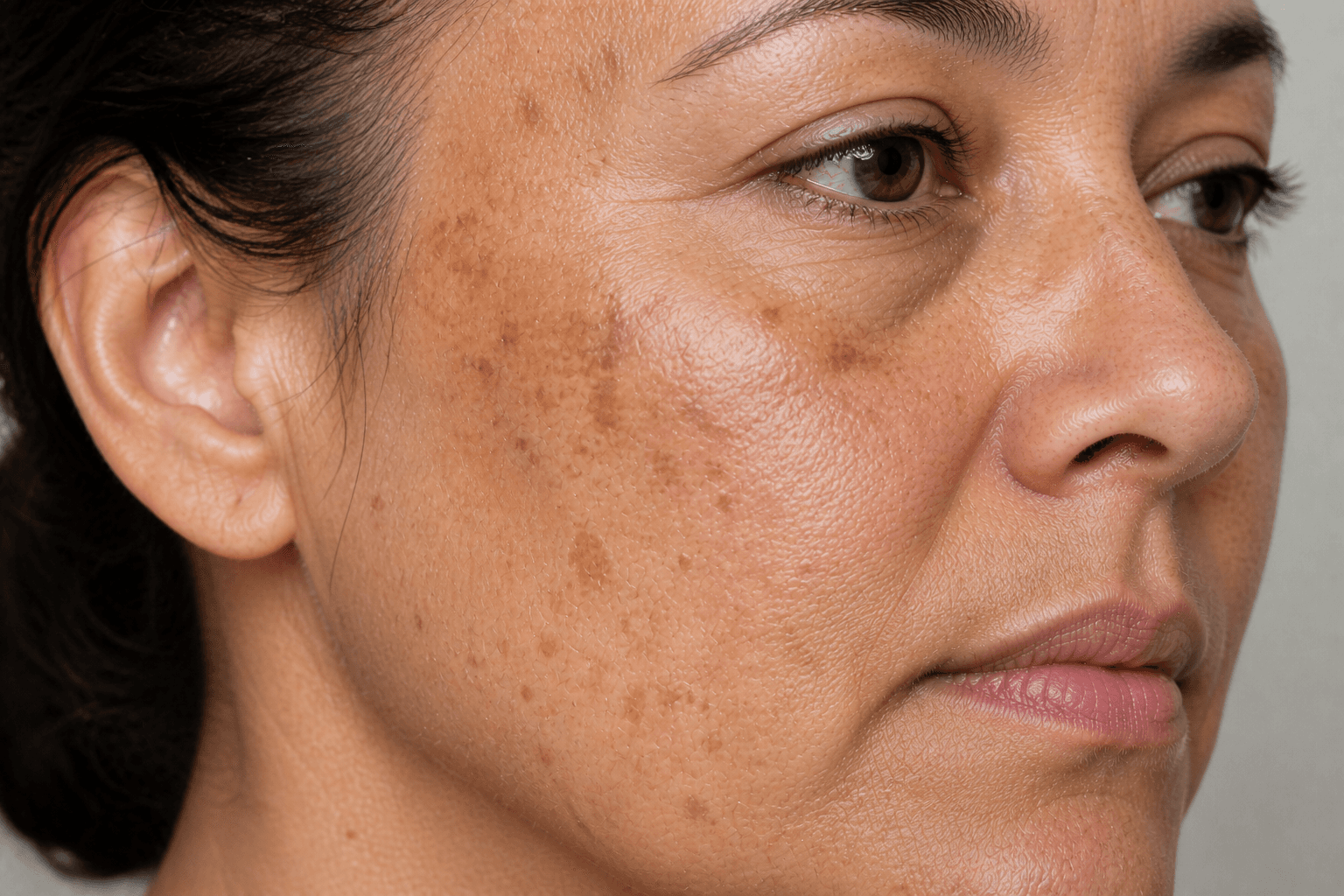
Most of what patients call "aging" is actually photoaging. UV exposure across a lifetime accumulates as fine lines, brown spots, broken capillaries, rough texture, and a generalized dullness that no amount of skincare seems to crack. The good news: photoaging responds well to clinical resurfacing and pigment work, provided the protocol matches your skin type. The catch: nothing holds without daily SPF.
- All Fitzpatrick skin types
- Physician-supervised
- Pigment-safe protocols
- Bilingual care
What this is
What sun damage actually is
Photoaging is UV-driven cumulative damage to the skin’s collagen, elastin, and melanocytes. It shows up as a constellation of changes, not a single symptom. Flat brown spots (solar lentigines) on the cheeks, forehead, and back of the hands. Fine criss-cross lines on the cheeks and around the eyes that pre-date deeper wrinkles. Broken capillaries (telangiectasias) along the nose and cheeks. Rough sandpaper texture across the cheeks. And a uniformly duller, more leathery skin surface than you remember having ten years ago.
Raleigh sits at 35 degrees north latitude with a long warm season and a UV index that hits 9 or 10 from May through September. Most of our patients report decades of pool time, beach time, lake time at Jordan or Falls, and the sort of casual high-dose UV exposure that adds up faster than people realize. By the late 30s, the cumulative damage is usually visible. By the 50s, it is usually undeniable.
Photoaging is not the same thing as melasma. Melasma is hormonally driven and chronic, and deserves its own protocol covered on a dedicated page. Sun damage is structurally different and responds more predictably to lasers, peels, and microneedling. Most patients have some of both, which is why a consultation matters.
At La Miel
How we treat sun damage
A complete plan touches three layers: the surface (clears existing pigment and texture), the dermis (rebuilds collagen damaged by UV), and the daily routine (prevents the damage from accumulating again).
Pigment-targeting lasers
Q-switched or picosecond lasers clear localized brown spots and sun spots in one to three sessions. For diffuse sun damage on Fitzpatrick I-III skin, IPL is highly effective. For Fitzpatrick IV-VI skin, we avoid IPL and use Nd:YAG or alternative platforms at conservative settings.
Suited for: Brown spots, age spots, vascular redness, diffuse photoaging.
Fractional laser resurfacing
Non-ablative fractional lasers rebuild collagen and smooth surface texture across multiple sessions. We choose the platform by skin type and tailor settings to your Fitzpatrick category.
Suited for: Fine lines, rough texture, mild scarring layered with sun damage.
Medical-grade chemical peels
Glycolic, mandelic, lactic, and Jessner formulations accelerate cell turnover, fade surface pigmentation, and refresh the skin’s overall feel. Series of four to six over three months delivers a noticeable change for most patients.
Suited for: Surface dullness, mild pigmentation, ongoing maintenance.
Microneedling with PRF or brightening actives
Microneedling drives topicals deeper than they can otherwise penetrate and triggers collagen production. Paired with PRF or pigment inhibitors, it is one of our safer protocols for melanin-rich skin.
Suited for: All Fitzpatrick types, layered pigment and texture concerns.
Topical retinoids and antioxidant skincare
Prescription-strength retinoids (tretinoin, adapalene) drive cell turnover, fade pigment, and rebuild collagen over months. Paired with vitamin C, niacinamide, and a tinted mineral SPF, this is the routine that holds your in-clinic results.
Suited for: Long-term maintenance, daily prevention.
Daily SPF (the non-negotiable part)
A medical-grade broad-spectrum SPF 30 or higher, applied daily, blocks the UV exposure that keeps generating new damage. Tinted mineral formulations with iron oxides also block visible light, which matters for pigment-prone skin. Without consistent SPF, every treatment above is fighting a losing battle.
Ready to start?
A consultation tells us what your skin needs. It takes under an hour.
What to expect
What to expect, from consult to result
Consultation
We map your sun damage pattern (pigment, texture, vascular redness, fine lines), photograph in standardized lighting, and lay out a sequence that handles your specific mix. We screen for melasma overlap and adjust the plan if found.
Active series
Most plans run three to six in-clinic sessions over three to six months. Laser sessions stand alone with their own recovery; peel sessions are shorter and easier to layer.
Recovery
Pigment laser: redness 24 to 48 hours, darkened spots flake off over 7 to 14 days. Fractional laser: redness and grid pattern 5 to 14 days. Peels: mild flaking 3 to 7 days depending on depth.
Results
Brown spots fade across the active series. Collagen continues remodeling for six months after the last session. Plan to reassess at month nine, with annual maintenance thereafter.
Common questions
Frequently asked questions
The best treatment depends on which kind of sun damage you have. Localized brown spots and age spots respond fastest to pigment-targeting lasers, typically one to three sessions. Diffuse texture and fine lines respond to fractional laser resurfacing or a microneedling series. Surface dullness responds quickly to medical-grade chemical peels. Most patients benefit from a layered protocol that addresses all three. Daily SPF holds whatever the clinical work achieves.
Ready to map your plan?
Tell us what you would like to address. We will recommend a sequence that actually fits your skin, your anatomy, and your timeline.
Ready When You Are
Two ways to start: book the specific treatment you came for, or book a consultation and we will build your plan together.
Tue to Wed 10 to 5, Thu 10 to 9, Fri 10 to 3. Closed Sat to Mon.
7718 Six Forks Road, Suite 106, Raleigh, NC 27615