
Skin Quality & Tone
Acne scarring in Raleigh, treated as a structural problem.
Acne scars are not a surface issue, which is why surface treatments rarely move them. Atrophic scars (icepick, boxcar, rolling) sit in the dermis as collagen deficits. Hypertrophic and keloid scars sit as collagen excess. Both respond to clinical protocols. Neither responds to a single treatment in isolation. At La Miel Aesthetics, scar work is planned by our master-certified RN Adriana Sandoval under the medical direction of Dr. Susan Lovelle, MD.
- All Fitzpatrick skin types
- Physician-supervised
- Layered protocols
- Bilingual care
What this is
The four scars that make up "acne scarring"
When patients say "acne scars," they usually mean one of four distinct patterns, each with its own clinical behavior. Treating them well starts with naming what you actually have.
Icepick scars are narrow, deep, vertical pits, often on the cheeks. The walls are tight and the base is dermal or sub-dermal. These respond least predictably to microneedling alone and often need TCA cross, punch excision, or focused laser to make a real dent.
Boxcar scars are wider depressions with sharp edges, like small shallow pans. They respond to RF microneedling, fractional resurfacing, and (for the right defect) a small placement of HA filler to lift the floor.
Rolling scars create a wavy, undulating surface across the cheek, the result of fibrous bands tethering the skin to deeper tissue. Subcision (a needle release of those tethers) plus RF microneedling or biostimulator placement is the most reliable plan.
Hypertrophic and keloid scars are raised, often pink or darker than the surrounding skin, and most common on the jawline, chest, and back. They need a different approach: intralesional steroid injection, gentle laser, silicone protocols. Aggressive resurfacing on a keloid-prone patient can make things worse.
At La Miel
Our scar revision protocols
Most patients need two or three modalities sequenced over 6 to 12 months. A single device alone does not deliver the result patients are hoping for. Below are the tools we use, paired to the scar type we use them for.
RF microneedling
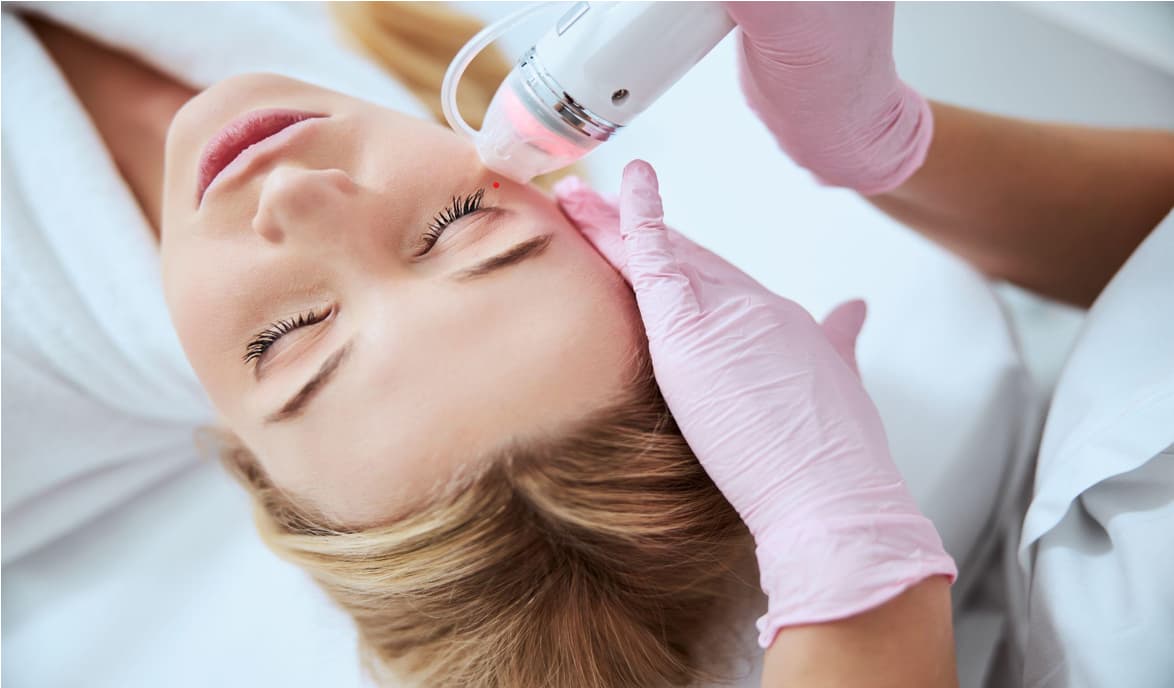
Radiofrequency energy delivered into the dermis through fine needles. Triggers collagen and elastin remodeling at depth. Our workhorse for rolling scars and shallow boxcar scars, safe across Fitzpatrick I to VI.
Suited for: Rolling scars, shallow boxcar scars, all skin tones.
Subcision
A blunt-tipped needle or cannula releases the fibrous bands that tether rolling scars to deeper tissue. Done at the same session as RF microneedling or filler, it converts a dense rolling scar into a flatter surface that subsequent collagen induction can finish.
Suited for: Rolling scars, tethered scars on the cheek and jawline.
Fractional laser resurfacing
Pixelated thermal injury triggers deep dermal rebuilding while leaving healthy tissue between treatment columns. We select the platform by skin type: gentler non-ablative settings for Fitzpatrick IV-VI, more aggressive parameters for lighter skin.
Suited for: Boxcar scars, mixed scar fields, significant texture damage.
Hyaluronic acid filler (selective)
A small, carefully placed filler under a boxcar or rolling scar can lift the floor of the depression and restore surface flatness. Not a fit for icepick scars or for patients with active acne. Used as a finishing modality, not a primary plan.
Suited for: Specific boxcar or rolling depressions, post-resurfacing finishing.
Chemical peels (Face Reality and beyond)
Medical-grade peels improve overall texture, fade post-inflammatory hyperpigmentation that often accompanies scarring, and prepare skin for in-clinic procedures. Face Reality peels are specifically formulated for acne-damaged skin.
Suited for: Active or recent acne, PIH alongside scarring, maintenance between sessions.
Ready to start?
A consultation tells us what your skin needs. It takes under an hour.
What to expect
What to expect, from consultation to result
Scar revision is a series, not an event. A realistic plan is six to twelve months for visible structural change. Patients who want a single appointment that "fixes" scarring leave disappointed; patients who commit to a layered protocol usually see 50 to 70 percent improvement.
Consultation
We map your scars by type, photograph in standardized lighting, review your acne history and any medications, and lay out a sequence. We screen for keloid risk and active acne, both of which change the plan.
Active treatment
Typically three to six in-clinic sessions spaced four to eight weeks apart. Subcision and RF microneedling often share a visit. Laser sessions stand alone with their own recovery window.
Recovery per session
RF microneedling: redness 24 to 72 hours, mild pinpoint scabbing up to a week. Subcision: localized bruising up to two weeks. Fractional laser: redness and grid pattern 5 to 14 days depending on settings.
Results
Collagen remodeling continues for six months after your last session. Plan to reassess at month nine, not month two. Maintenance is one to two sessions per year for most patients.
Common questions
Frequently asked questions
The best treatment for acne scars depends on the scar type. Rolling scars respond best to subcision combined with RF microneedling. Boxcar scars respond to fractional laser resurfacing, sometimes with HA filler to lift the depression. Icepick scars are the most stubborn and often need TCA cross or punch excision. Hypertrophic and keloid scars need a different approach using steroid injections and gentle laser. A single device rarely works alone, so most successful plans combine two or three modalities over six to twelve months.
Ready to map your plan?
Tell us what you would like to address. We will recommend a sequence that actually fits your skin, your anatomy, and your timeline.
Ready When You Are
Two ways to start: book the specific treatment you came for, or book a consultation and we will build your plan together.
Tue to Wed 10 to 5, Thu 10 to 9, Fri 10 to 3. Closed Sat to Mon.
7718 Six Forks Road, Suite 106, Raleigh, NC 27615